

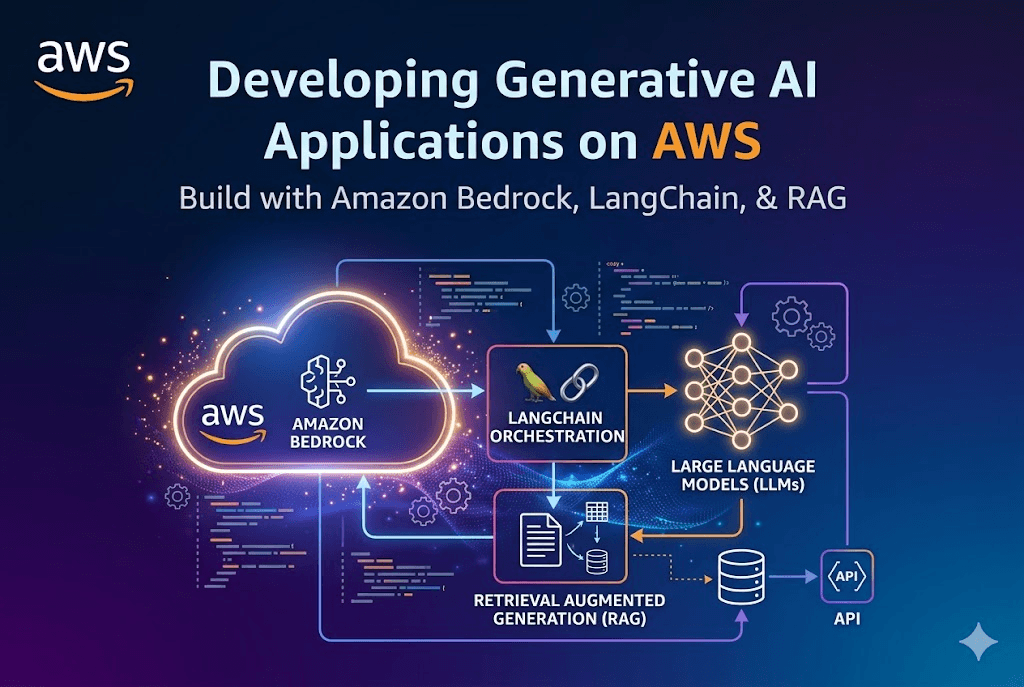
Developing Generative AI Applications on AWS
Field | Description / Template |
|---|---|
Purpose | To enable software developers to build and architect generative AI applications using Large Language Models (LLMs) via Amazon Bedrock and LangChain, focusing on implementation without the need for fine-tuning. |
Audience | Software developers and engineers looking to integrate advanced AI capabilities into their applications. |
Role | Software Developers, Full Stack Engineers, AI Engineers, and Cloud Architects. |
Domain | AI/ML / Generative AI / Cloud Development. |
Skill Level | Intermediate |
Style | Technical deep-dive featuring architectural theory, best practices in prompt engineering, and hands-on application building using RAG patterns. |
Duration | 2 Days |
Related Technologies | Amazon Bedrock, LLMs, LangChain, Python, Retrieval Augmented Generation (RAG). |
Course Description
This course is designed to introduce generative artificial intelligence (AI) to software developers interested in using large language models (LLMs) without fine-tuning. The course provides an overview of generative AI, planning a generative AI project, getting started with Amazon Bedrock, the foundations of prompt engineering, and the architecture patterns to build generative AI applications using Amazon Bedrock and LangChain.
Who is this course for
This course is intended for software developers who want to leverage the power of LLMs and foundation models within the AWS ecosystem. It is specifically designed for those who prefer using APIs and orchestration frameworks like LangChain over manual model training or fine-tuning.
Course Objectives
Fundamental Theory: Describe generative AI alignment with machine learning and identify potential risks and business value.
Amazon Bedrock Mastery: Understand Bedrock's cost structure, APIs, and architecture patterns; implement console-based demonstrations.
Prompt Engineering: Apply zero-shot, few-shot, and advanced prompt techniques while mitigating bias and misuse.
Architectural Patterns: Identify components of a GenAI application and use LangChain to integrate LLMs, chains, and document loaders.
Practical Application: Build and test real-world use cases using the Retrieval Augmented Generation (RAG) approach and Agents for Amazon Bedrock.
Prerequisites
Required: Completed AWS Technical Essentials.
Technical Skill: Intermediate-level proficiency in Python.
Course outline
Section 1: Introduction to Generative AI – Art of the Possible
Overview of ML
Basics of generative AI
Generative AI use cases
Generative AI in practice
Risks and benefits
Section 2: Planning a Generative AI Project
Generative AI fundamentals
Generative AI in practice
Generative AI context
Steps in planning a generative AI project
Risks and mitigation
Section 3: Getting Started with Amazon Bedrock
Introduction to Amazon Bedrock
Architecture and use cases
How to use Amazon Bedrock
Demonstration: Setting up Bedrock access and using playgrounds
Section 4: Foundations of Prompt Engineering
Basics of foundation models
Fundamentals of prompt engineering
Basic prompt techniques
Advanced prompt techniques
Model-specific prompt techniques
Demonstration: Fine-tuning a basic text prompt
Addressing prompt misuses
Mitigating bias
Demonstration: Image bias mitigation
Section 5: Amazon Bedrock Application Components
Overview of generative AI application components
Foundation models and the FM interface
Working with datasets and embeddings
Demonstration: Word embeddings
Additional application components
Retrieval Augmented Generation (RAG)
Model fine-tuning
Securing generative AI applications
Generative AI application architecture
Section 6: Amazon Bedrock Foundation Models
Introduction to Amazon Bedrock foundation models
Using Amazon Bedrock FMs for inference
Amazon Bedrock methods
Data protection and auditability
Demonstration: Invoke Bedrock model for text generation using zero-shot prompt
Section 7: LangChain
Optimizing LLM performance
Using models with LangChain
Constructing prompts
Demonstration: Bedrock with LangChain using a prompt that includes context
Structuring documents with indexes
Storing and retrieving data with memory
Using chains to sequence components
Managing external resources with LangChain agents
Section 8: Architecture Patterns
Introduction to architecture patterns
Text summarization
Lab: Text summarization of small files with Anthropic Claude
Lab: Abstractive text summarization with Amazon Titan using LangChain
Lab: Using Amazon Bedrock for question answering
Chatbot
Lab: Conversational interface – Chatbot with AI21 LLM
Code generation
Lab: Using Amazon Bedrock models for code generation
LangChain and agents for Amazon Bedrock
Lab: Integrating Amazon Bedrock models with LangChain agents